

April 9, 2020
Face Masks Mandatory for Ellsworth AFB Shoppers
ELLSWORTH AIR FORCE BASE, S.D. – Due to a new Defense Commissary Agency (DeCA) policy, effective Saturday, April 11, all patrons and employees at the base commissary and Army and Air Force Exchange (AAFES) facilities will be required to wear face coverings to help limit the spread of 2019 Novel Coronavirus (COVID-19).
DeCA sent out the new policy April 9 making face coverings mandatory for facilities worldwide starting April 10. After a thorough review and consultation with base leaders, the 28th Bomb Wing commander directed the policy be delayed until April 11 at Ellsworth to ensure the base community and store patrons are aware of the change.
“More importantly, the extra time will give people an opportunity to obtain masks and ensure they are able to comply with the new policy,” said Col. David Doss, 28th BW commander.
As of noon April 9, the South Dakota Department of Health reported 447 people have tested positive for COVID-19 in the state, with eight cases originating in the counties immediately adjacent to Ellsworth. Because of the limited spread of the virus in the immediate area, the availability and wear of face coverings is not yet as common as it is in other locations.
The wing commander recently authorized the voluntary wear of personally procured face coverings. The base is expecting a shipment of unit-purchased face coverings for distribution to Ellsworth personnel next week.
Ellsworth has been in Health Protection Condition (HPCON) level Charlie since March 25. There have been no reported cases of COVID-19 on Ellsworth, however, the base declared a Public Health Emergency the same day it moved to HPCON Charlie to align base measures with existing precautionary measures, and help educate personnel in preventing potential widespread outbreak.
For more information, call the 28th Bomb Wing Public Affairs Office at (605) 385-5056.

March 25, 2020
March 23, 2020
Ellsworth AFB Cancels Visitors Passes & Modifies Commissary Hours
Base officials have coordinated with the Defense Commissary Agency to adjust the hours of service at the Ellsworth commissary to ensure access to basic necessities for mission essential personnel, and have also announced that issuance of visitor passes to access the installation will be suspended. All currently valid visitor passes will expire on March 25.
Until further notice, the first two hours of operations each day at the base commissary will be for active-duty members and their families. After the first two hours, the commissary will open to all other individuals authorized to shop at the store. The store will continue to ration high turnover items.
To further reduce traffic and the number of visitors onto the installation, and to combat the spread of COVID-19, effective immediately the base will not issue visitor passes without an exception to policy letter. Exceptions to the policy must be routed through an Airman’s squadron commander for approval. Reasons that will merit strong consideration for an exception to policy include requests for childcare or new baby assistance; college students who are home and do not have an ID; and other humanitarian or hardship issues. The change will not impact contractors or deliveries at this time.
“These are part of our proactive measures to ensure the safety and welfare of our Airmen, their families, and the entire community, all-the-while making sure we remain capable of accomplishing our mission of providing combat power – anytime, anywhere,” said Col. David Doss, 28th Bomb Wing commander. “Our first priority is the health and well-being of our team and our community. These measures help us do that.”
As of March 22, Ellsworth is in Health Protection Condition (HPCON) Alpha+. HPCON A is determined when there is a limited threat to personnel based on the existence of a disease, or unusual human health threat that has the potential to rapidly move into the local area. The base continues to test its members who meet criteria, and work with local health care providers to ensure it has the most updated information and access to care for all Airmen, their families and those who rely on Ellsworth for their health care needs.
March 16, 2020
Pentagon Bans Domestic Travel for Troops and Families
This article by Gina Harkins originally appeared on Military.com, the premier resource for the military and veteran community. Get more coronavirus news and resources at MOAA.org/coronavirus.

Pentagon officials announced sweeping travel restrictions for troops and their families late March 13 that will halt all domestic travel, including duty station moves and temporary assignments, for nearly two months as officials try to stem the spread of the deadly coronavirus.
Starting March 16, service members, their families and Defense Department civilian workers are restricted in how they can move about the U.S. and its territories. The unprecedented moves were approved by Deputy Defense Secretary David Norquist and extend through May 11.
A memo outlining the restrictions say the continuing spread of the new coronavirus, or COVID-19, necessitates immediate action.
"These restrictions are necessary to preserve force readiness, limit the continuing spread of the virus, and preserve the health and welfare of Service members, DoD civilian employees, their families, and the local communities in which we live," the memo adds.
[RELATED AT MILITARY.COM: Here’s What the Coronavirus Travel Ban Means for Military Families]
The measures were announced just hours after President Donald Trump declared the global pandemic a national emergency in the U.S.
The new rules apply to all Defense Department military and civilian personnel assigned to military bases or facilities inside the U.S. and its territories. The memo also applies to family members of those personnel.
It temporarily halts permanent change of station moves and temporary duty assignments, but allows travel for medical reasons.
Those already out on temporary assignments will be allowed to return to their home station when that mission ends. Service members approaching retirement or end-of-duty contracts are also exempt from the travel restrictions.
Coronavirus Resources
- Centers for Disease Control and Prevention Coronavirus Website
- CDC Advice for Higher-Risk Individuals
- VA Coronavirus Website
- TRICARE Coronavirus Information
- DoD Coronavirus Response Website
- Health.mil Coronavirus Information
- National Institutes of Health Coronavirus Information
- Latest Coronavirus News from Military.com
- Latest Coronavirus News from Military Times
Otherwise travel will only be approved if it's determined to be mission-essential, is necessary for humanitarian reasons, or warranted due to extreme hardship, the memo adds. Only top brass or civilian leaders are allowed to grant those exemptions.
"These exceptions are to be done on a case by case basis, shall be limited in number, and shall be coordinated between the gaining and losing organizations, as appropriate," the memo states.
Another memo also issued late March 13 introduced a host of new restrictions at the Pentagon. Outside tours of the building are canceled, international military partners will no longer be allowed to visit, and anyone who has traveled outside the U.S. must not enter the Pentagon for at least 14 days.
A news release from the Defense Department announcing the new rules says additional guidance surrounding the coronavirus will be issued "as conditions warrant."
"Our goal is to remain ahead of the virus spread to our military force remains effective and ready," it states.
February 13, 2020
Defense Health Agency director responds to MOAA's concerns
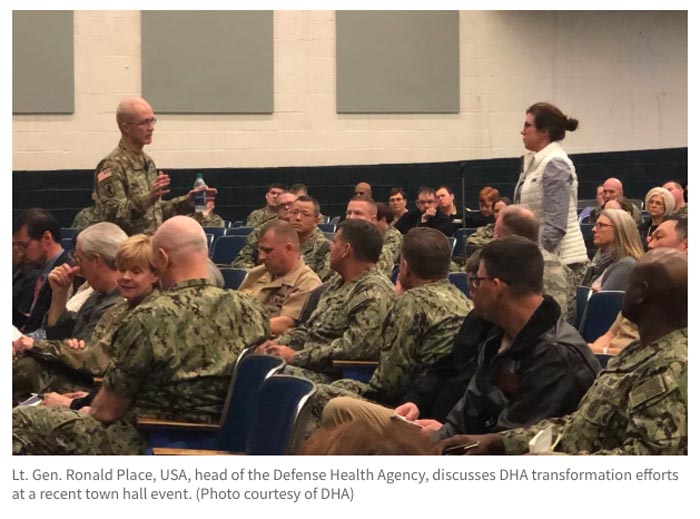
Note from MOAA: This column from Lt. Gen. Ronald Place, USA, director of the Defense Health Agency, is a response to MOAA's Jan. 22 article, Military Families Need a Safety Net During Military Health System Reform.
My highest priority as director of the Defense Health Agency is great outcomes for every patient we care for – and not only great by our definition, but by the standards our patients set for us. Listening to our beneficiaries – directly and through groups like MOAA that represent them – is an essential part of achieving those great outcomes. When military service and veterans support organizations speak, we listen.
I was concerned recently when senior MOAA representatives raised public questions about the DHA’s management of military hospitals and clinics. As I understand it, MOAA’s concerns center on four issues:
- A fear that we lack the ability to track, identify and resolve problems when they arise system-wide or in specific locations.
- The lack of an online reporting tool for patients to report access-to-care issues.
- A desire to see facility-by-facility metrics for access to care.
- The belief that patients should be able to switch to TRICARE Select’s civilian networks at any time if dissatisfied with their military provider.
It’s important to note that this first issue – the need to track issues of quality, safety, or access to care across the system – is precisely why we’re unifying military hospitals and clinics under the DHA. A single, unified system is able to set best-in-class standards, monitor performance, and ensure accountability. The DHA is working to do just that. In September, the DHA issued a manual for managing clinical quality and safety which established – for the first time in the Department of Defense – a single, high standard for all military health care facilities. Similarly, we are standardizing access to care criteria across the system using both military and civilian high-performing facilities as examples. And we are monitoring system-wide performance to ensure we are meeting those high standards.
I wholeheartedly agree with MOAA leaders when it comes to public transparency on access to care for each facility. In fact, our actions verify these intentions as the Military Health System already posts this data on our Transparency website (https://www.health.mil/transparency). This site provides public access to survey data from each MTF, including showing the percentage of surveyed patients who are satisfied with their ability to get needed care. It also includes access to TRICARE Consumer Watch reports for nearly 100 hospitals and clinics with annual and quarterly reports on access to care. This is in addition to reporting a wealth of quality and safety metrics in the Hospital Compare system, allowing a side-by-side comparison with our civilian counterparts. Finally, the DHA began submitting all of our in-patient facilities for analysis in Leapfrog’s Hospital Safety Grade system last year. Our record on transparency far exceeds those of civilian health systems, which is entirely appropriate given the population we serve. We will continue to expand the information available to help our patients assess our performance and make decisions about their health care.
When patients feel they aren’t getting the access to care they need, they’re encouraged to report those issues to on-site patient advocates, beneficiary counseling and assistance coordinators, or facility staff. The Agency’s healthcare operations staff is developing standard customer service and patient advocate processes to improve patient experience and facilitate resolution of patient concerns. Again, our move to a unified system allows us to enforce those standards for all facilities. One component of the new patient advocate processes is a requirement for our hospitals and clinics to upload access and other concerns into an existing DHA portal. The agency’s healthcare operations staff will use that information to monitor compliance, identify trends, and more importantly, develop solutions.
Creating a patient-facing online reporting tool for access issues is worthy of strong consideration; however, we would need to find the resources within our existing budget to employ and manage such a tool. I’ve asked my staff to explore options and report back to me so we can determine its feasibility now and into the future.
Lastly, MOAA has advocated for allowing beneficiaries to switch from receiving care in military facilities to the TRICARE Select network at any time – even outside the annual Open Season enrollment period. It’s important for our patients to understand why Congress instituted the annual enrollment requirement for TRICARE, just like a huge majority of private insurance plans. Simply put, annual enrollment allows us to project and plan what capabilities we need to provide for the health needs of our beneficiaries.
Knowing the number of patients enrolled in our facilities allows us to allocate scarce medical resources and be ready to augment our uniformed staff with civilian or contract personnel. We are much better able to plan for providing you the best possible care if we’re able to accurately project the demand for care. If we can’t accurately project that demand, it’s harder to provide the care each of you deserve. If patients in our facilities are dissatisfied with their care, I want to know about it, and believe me, our facility directors want to know about it too. We want the chance to address a patient’s issue and each of our directors has the authority they need to meet your needs.
Every day, we work diligently to meet the high expectations of our patients. Groups like MOAA are essential to helping us. I am grateful for their input and assistance communicating to our patients. Together, we can ensure the health care we provide through the military health system meets our highest standards.
January 31, 2020
Subscribe to:
Posts (Atom)